
Who’s at the Table?
I once worked on a project with a company delivering meal kits made entirely with plant-based ingredients. They wanted to retool their brand identity and messaging as they transitioned from start-up to growth phase, with a focus on really nailing their value proposition.
I was early in my design career and playing a supporting role on the project. I hadn’t yet formed the necessary optimism that makes for a good designer. I remember thinking that the sum total of vegans wasn’t much of a market. A quick Google search kicks back anywhere from 1–3% of Americans who adhere to an entirely plant-based diet. Even if we could convince ALL vegans to sign up — for the convenience, variety, taste, or fun of it — it didn’t feel like that many folks were out there for us to reach.
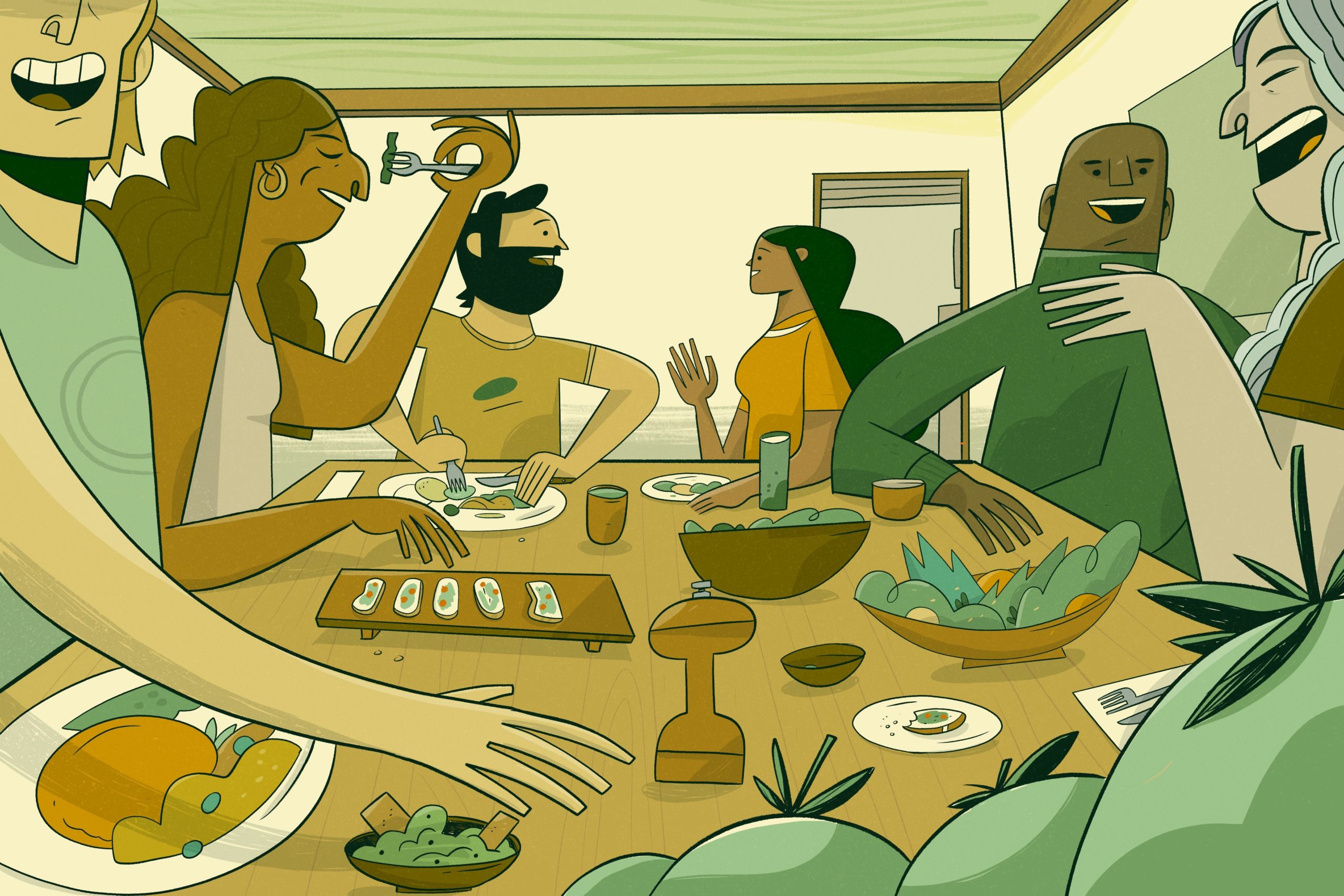
As part of research, we joined a few families and groups of friends as they used the meal kit in the course of a normal weeknight. We sent them a kit, and then showed up in person to observe them as they opened the kit, cooked the food, and enjoyed the meal. We took pictures, recorded videos, and asked questions about their experience. It was the kind of immersive research you dream of getting to do — where you are face to face with a product and its user in the wild. And it was fun. Sometimes we hung back awkwardly. Other times we were invited to join in with the finished product. And every time, we had fascinating conversations about food and health and diet.
Fortunately, there were plenty of non-vegans around these tables. We learned a lot about their concerns or misunderstandings about a plant-based diet.
“I don’t like the texture.”
“It’s hard to cook this way.”
“I’m not sure I’ll get all the nutrients I need.”
Amidst their misgivings, lots of folks were vegan curious. They might not have been ready to give up animal products in their diet entirely, but they expressed a desire to cut back on red meat or food that was less taxing on the environment to produce.
At the final dinner party, one non-vegan said, “You know what? This would be an easy way for me to eliminate some meat from 2–3 meals a week.”
That’s when my colleague realized the insight: vegan meals kits aren’t just for vegans.
For them, it wasn’t about going entirely vegan. It was an easy way to take a first step — their own version of a Meatless Monday. It was not about learning a whole new way of planning and cooking meals. It was getting all the ingredients and step by step support delivered right to their doorstep.
Seeing the opportunity this way unlocked a whole new way of thinking about the client’s brand strategy. It also opened up a much wider market than the handful of vegans looking for an easier way to cook at home. This was core to the company’s mission to encourage more people to adopt a plant-based diet.
I think about this project a lot. For me, it was an early example of the power of seeing a problem differently and the way that can unlock an entirely new approach. To this day, I look back on some of the things that led us to that insight and try to apply them in my own work.
Am I bringing the right people to the table?
At this point, no one questions the wisdom of “starting with the end user in mind” or “using empathy to better understand a need.” That’s baked into any good design, strategy, or brand process. But setting the right table with the right guests can be a challenge. Sometimes the people we need to talk to aren’t the first folks who come to mind. What could custodial staff teach us about how space creates opportunities for learning? How might travel agents in other cities inform a strategy for attracting tourists to a community? What could vegans teach us about the future of sustainable animal products?
Am I asking the right questions or solving the right problem?
We typically write interview guides when we’re doing 1-on-1s with stakeholders or facilitating focus groups. I often find that after the first question or two, I tend to go off rails — much to the frustration of my colleagues. Inevitably, someone says something interesting and I want to pull on that thread. There’s value in staying on script to see different responses to the same questions. But don’t be afraid to throw the script out the window. Instead of saying “Thank you — now back to the vegans,” it was useful to follow the thread of conversation with the meat eaters at the table. It revealed that we weren’t thinking about the challenge in the right way. Instead of “How can we reach more vegans?” we saw that our ambitions weren’t big enough.
Am I having fun?
The typical format of interview and group conversations can feel unnatural. But putting people in comfortable situations in their everyday lives can help bring their guard down, inviting honesty and candor. We had to make time and space for that kind of noticing, but like most things, it’s worth the extra effort. This is one of the gifts of approaches like Design Thinking: the element of play. It creates room for the unexpected, in the same way a dinner party or participating in a classroom — not merely observing — might.
Am I paying attention?
Insights can be found just about anywhere, if you’re paying attention. During the meal kit project, I was so focused on the task at hand — understanding vegans — that I wasn’t paying attention to others. I was looking for some detail about the unboxing or the cooking or the flavor that might help us reach more vegans. Thankfully, my colleague had their eyes wide open. They looked at the neighborhoods we visited, asked questions about prior eating habits, looked around the room for what was unsaid as much as they listened for what was said.
The memory of this project serves as a constant reminder to be aware of the ways I may be unaware. When the question is confusing, aha’s aren’t giving themselves up easily, or the conversation feels stale, I return to these questions. I look for the people I might not expect to hold the answer — and invite them to join us as the table.

LEAP for Education
Donors needed a strategy—and a story—that inspired long-term commitment.
Spartanburg Academic Movement
Everyone could explain their own thread. The tapestry was another story.
Edgility Search
A refreshed brand that turns unconventional rigor into clear differentiation.
Turn Purpose Into Power
Leave an unforgettable mark. Make an unbelievable impact.